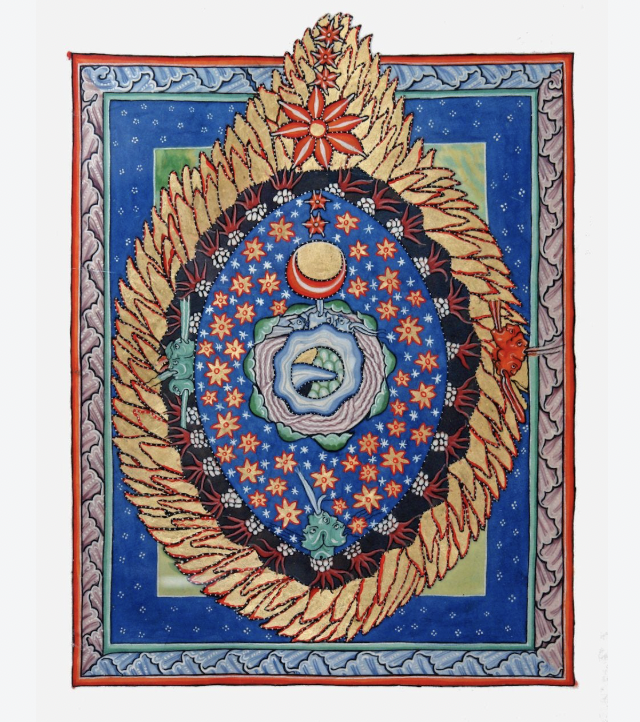
Hildegard of Bingen. Scivias Codex: Book I, Third Vision, The Universe, between 1141 and 1151.
What does it mean to become human? We are born into a body, a family, a culture and a world already in motion. We inherit names, beliefs, histories and ways of understanding ourselves. We learn to recognise the world through the images it gives us, the stories it tells us, the boundaries it draws between what is real and what is not. Over time, these structures become so familiar that we may mistake them for the natural order of things. Yet nothing remains untouched by time. What was once certain becomes questionable. What seemed eternal reveals its history. The individual changes, and with it the worlds we create.
This is true not only of human beings but of nations, kingdoms, communities and civilisations. Every culture carries images of its origins, creation myths through which it understands its place in the world. Some become sacred, others political, others aesthetic. They shape the imagination long before we become conscious of their influence. They tell us where we came from, what we are, and what we might become.
Yet ideas are in motion. They shift, break apart and become something else. Life unsettles our certainties again and again, through encounter, loss, study, love and the slow passage of time. The structures through which we understand ourselves are not the same as the things they seek to explain. Perhaps being human involves learning to recognise this distinction. We are continually becoming, and so are the worlds we have made.
For me as an initiate, this process takes on another dimension. The ancient injunction to know thyself is not simply a call to acquire more knowledge about the self. It may also be a demand to unlearn, to question what has been inherited and look beyond the familiar explanations through which we have come to know who we are. The deeper the inquiry, the less certain the ground can become. What appeared to be the answer becomes another threshold.
I have long approached this mystery through images. Alchemical imagery, in particular, offers a language for things that resist easy explanation. A symbol does not simply illustrate an idea. It gives form to something that might otherwise remain beyond our grasp. It can awaken a recognition that precedes language, a memory that does not belong entirely to the conscious mind. Its meaning is rarely exhausted by a single interpretation. As we change, the image changes with us.
The Cosmic Egg is one such image. Across different mythologies and cosmological traditions, the egg appears as a vessel of origins, a world held in potential before its emergence into form. It brings together two conditions that seem difficult to reconcile. Something is already present, yet what it will become remains unknown.
Is the egg a vessel of primordial potential, from which the world emerges? Or does it contain an organising principle, a pattern through which potential unfolds? Is creation the appearance of something from nothing, or the revelation of something that was present but not yet manifest?
Perhaps these questions lead towards the same mystery. There is the potential to become, and there are the conditions through which becoming takes place. There is spirit, and there is form. In human experience, these seem bound together in what we call the soul. The soul is shaped by the body, by experience and by the world it inhabits, yet it cannot easily be reduced to any one of these. It is both participant and witness, formed by life and continually altered through living. We are nothing, and yet we are everything.
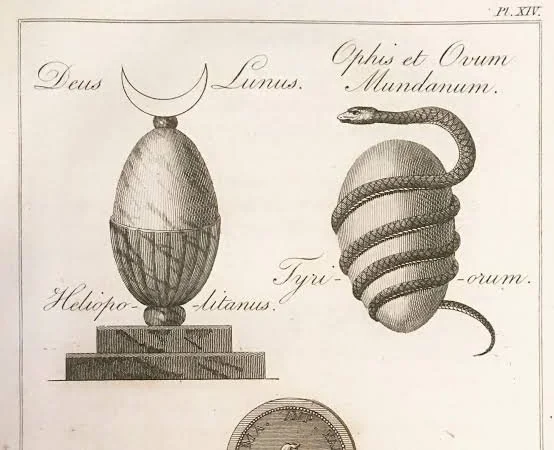
James Basire after Jacob Bryant, Ophis et ovum mundanum Tyriorum, 1774.
The world within the egg
The egg and the serpent appear together in this eighteenth-century engraving, published in Jacob Bryant's A New System, or an Analysis of Ancient Mythology. Bryant sought correspondences between the mythologies of ancient peoples, attempting to trace their symbols towards common origins. His interpretation belongs to the scholarship of his time, and the image should not be taken as proof that different ancient cultures shared one universal doctrine. Yet it offers a potent image through which to contemplate the relationship between origin, containment and emergence.
The egg establishes a boundary between what is held within and what has not yet become visible. It is not empty space awaiting something to fill it. It contains the conditions for life, though the form that life will take has not yet appeared. The serpent introduces another movement: continuity, return, the possibility that beginnings and endings are not separate events but parts of a greater cycle.
The world is held within the egg, yet the egg is not the world itself. What exists in potential is not the same as what has taken form. Between the two lies a process, and this process is where the mystery resides.
The image recalls the ancient question of the relationship between the microcosm and the macrocosm: the human being and the wider cosmos, distinct yet meaningfully related. Hermetic thought offers a way of contemplating these correspondences, and of asking whether the principles through which we understand ourselves might also tell us something about the order of the world.
We often speak of discovering our true selves, as though an already completed identity were hidden somewhere inside us, waiting to be uncovered. Yet life suggests something more complex. We are shaped by what we encounter, by the worlds we inhabit, by what we learn to perceive and by the choices we make. There may be something within us that precedes our conscious understanding, a capacity or inclination that has not yet found expression. But this does not necessarily mean that our future is already written.
A seed carries the conditions for its growth, yet what emerges depends on nourishment, environment and time. It can be damaged, neglected, cultivated or transformed by the circumstances in which it takes root. Potential is neither empty nor complete.
The Cosmic Egg holds this tension. It is not simply a finished world concealed inside a shell. It is a world in the process of becoming.
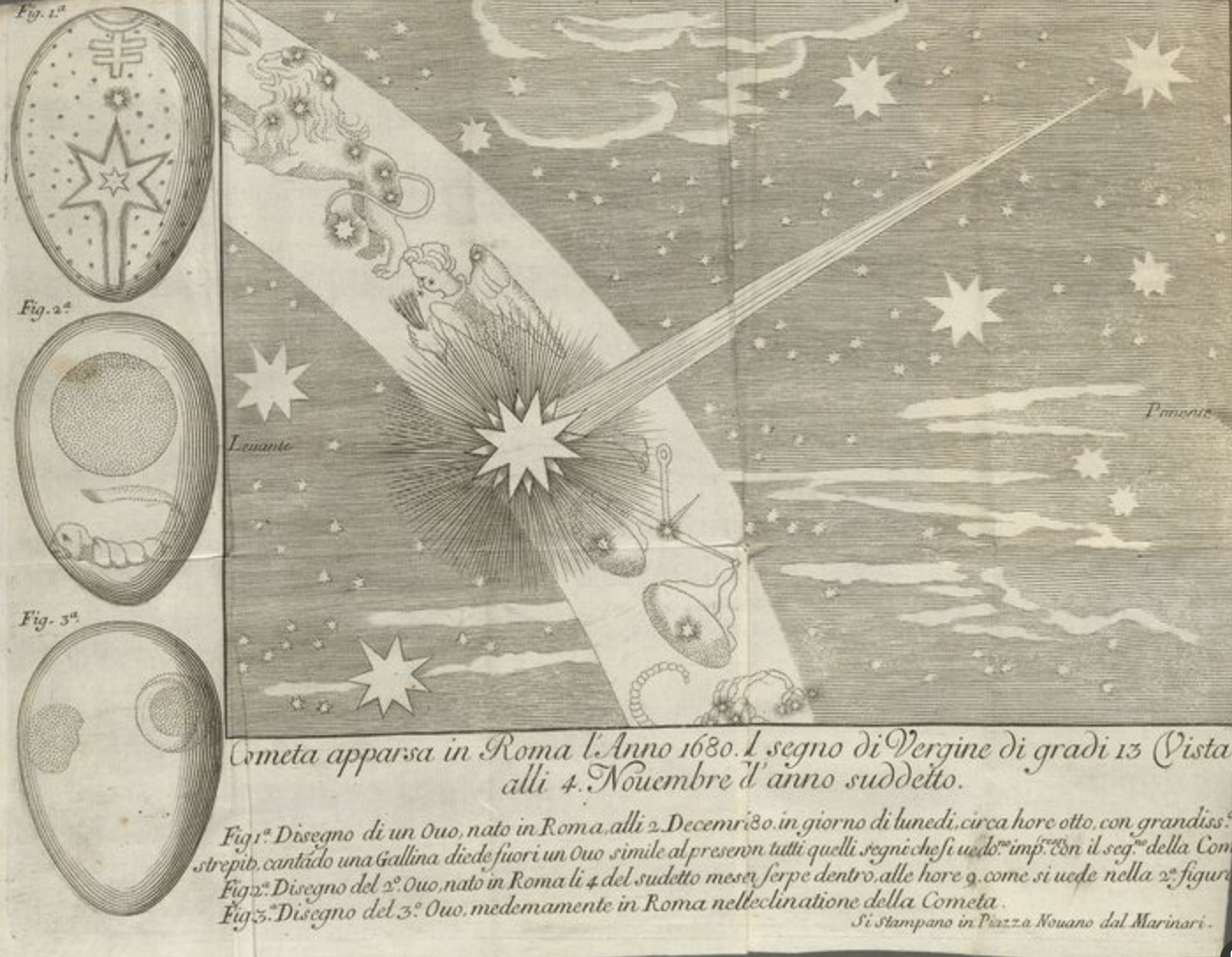
Mercure Galant, Cometa apparsa in Roma L'Anno 1680, 1681.
An unexpected appearance
In 1680, a spectacular comet crossed the European skies. Its appearance was recorded by astronomers, described in printed accounts and interpreted through the beliefs of the time. The image associated with Mercure Galant belongs to a period in which the observation of celestial phenomena was becoming increasingly systematic, while older understandings of heavenly signs continued to shape the imagination.
A separate Italian publication from the same year describes an extraordinary egg reportedly laid by a hen in Rome. According to the account, the egg bore markings resembling the comet. It was presented as a prodigious occurrence, as though the event in the heavens had left its imprint upon the earthly world.
We should not confuse this historical report with evidence that a comet literally appeared on an egg. What matters is the relationship the account establishes between the two. The great event above and the small object below become reflections of one another. The heavens are read through the earth, and the earth through the heavens. The unfamiliar is made visible through a form already associated with the emergence of life.
The comet itself was a visitor from the outer reaches of the Solar System, moving through the heavens according to physical laws that did not depend on whether human beings understood them. Yet its appearance unsettled the familiar sky. What had seemed distant and ordered became, for a time, strange.
A comet does not need to be an omen to change the way we see the world. Its arrival is enough to expose the limits of what we know. What happens when something from beyond our familiar world enters our field of awareness? What happens when we encounter something for which we have no adequate explanation?
The same question arises in our inner lives. A new idea, an unfamiliar desire, a sudden shift in perception can appear without warning. We may sense that something has changed before we have the language to describe it. An impulse arrives that does not fit the person we understand ourselves to be. It unsettles the established order, asking us either to make room for it or to force it back into the structures we already know.
Not every new impulse deserves to be followed, and not every unexpected experience reveals a deeper truth. Discernment remains essential. Yet there is a difference between questioning an unfamiliar idea and dismissing it simply because it cannot be accommodated by our existing understanding. Sometimes the first movement towards transformation is not the discovery of an answer, but the interruption of certainty.
As observation advanced, the comet became something that could be studied through its movement, its trajectory and its relation to the wider Solar System. What had once been interpreted through the language of signs could also be investigated through the laws of nature. The object had not changed. The framework through which it was understood had.
Our perception is shaped by what we have learned to recognise. We notice patterns, make associations and interpret new information through existing knowledge. This is part of how perception works, but it also means that what we are able to see is never entirely separate from what we have learned to expect. The question is not simply what exists beyond our understanding, but what conditions allow us to recognise it.
Comets are ancient travellers carrying material from the earliest days of our Solar System. Research into the early Earth suggests that impacts by asteroids and comets may have contributed water and organic molecules to the conditions from which life emerged. Material from the outer reaches of space became part of the chemistry of a developing world. Something from beyond enters the familiar and changes what is possible within it.
I believe inspiration works in a similar way. A new idea rarely arrives by following the same pathways of thought we have travelled a thousand times before. Sometimes an image, an unexpected connection or a sudden knowing appears before logic can account for it. We might speak of intuition, the unconscious, or the meeting of ideas that had not previously been brought together. The experience itself does not settle the question of where inspiration originates. It does, however, confront us with the limits of our own explanations.
That brings us to an important question: what allows us to receive something genuinely new? We may need to interrupt the architecture of habitual thinking, to become still enough to notice what is not yet familiar and to remain with an idea before deciding what it means. Silence does not guarantee revelation. But without some space between what we encounter and what we already believe, the unfamiliar can easily be reduced to the familiar.
Like a comet entering the sky of a known world, an unexpected impulse may bring new possibilities into our field of awareness. What follows depends on whether we recognise it, whether we give it space, and whether we possess the discernment to work with what it brings.
The Cosmic Egg offers a way to contemplate this interval between receiving an impulse and giving it form. A vessel of potential, a space of incubation, it holds what has begun but has not yet emerged.

Matthäus Merian, Emblem VIII from Michael Maier's Atalanta Fugiens, 1617.
The vessel and the fire
“Take an egg and strike it with a fiery sword.”
The instruction appears in Michael Maier's Atalanta Fugiens, an alchemical work in which engravings, epigrams, explanatory discourses and music are brought together to explore the mysteries of nature. In Emblem VIII, the egg becomes the subject of a process through which one form of life may give way to another. The image is not simply an invitation to destruction. It is an instruction concerning transformation.
The egg must be contained, but containment alone is not enough. Something must act upon it. In alchemical symbolism, the vessel establishes the conditions in which matter can be worked upon, while fire supplies the energy of change. The process requires both the holding of a form and the means through which that form may be transformed.
Maier invokes Mars and Vulcan, bringing martial force into relation with the fire of the forge. The sword suggests directed action; the fire suggests the energy through which matter is altered. Together they raise a difficult question. What kind of force is required for transformation, and how can it be distinguished from the force that merely destroys?
To speak of inner alchemy is to speak of this tension. The path does not consist simply of accumulating knowledge, collecting spiritual experiences or adding new beliefs to those we already hold. It can bring us into contact with the assumptions we have inherited, the identities we have constructed and the illusions through which we mistake our habits for our nature.
Something must become permeable to change. The familiar must be questioned. What has been taken for granted must be brought into the light. Yet it would be a mistake to imagine that everything we have been should be discarded. The work requires discernment: to recognise what must be released, what must be confronted, and what deserves to be refined and carried forward. If we destroy indiscriminately, we lose not only what confines us but also what sustains us. If we refuse all change, what was once a vessel becomes a prison.
This is one of the dangers in esoteric practice. The desire for purification can become a rejection of the very material through which transformation must take place. In the pursuit of light, we may deny the shadow; in the pursuit of perfection, we may destroy the imperfect conditions through which we learn. What is rejected does not necessarily disappear. It may return in another form, beyond our recognition or control.
The alchemical furnace is not simply a fire that burns away the old. It is a place where matter is subjected to conditions that allow its qualities to be revealed, separated and recombined. Heat must be regulated. The vessel must hold. The process must be sustained.
The inner fire, then, is not only the force that breaks through our illusions. It is also the passion of the heart, the strength of attention, the light through which we try to distinguish what is true from what we merely wish to believe. Transformation demands courage, but courage without discernment can become recklessness. Purification without compassion often becomes another form of violence.
The egg reminds us that becoming requires both protection and change. Too much force, and the vessel is destroyed before life can emerge. Too little, and what is held within remains untransformed. The work lies in the relationship between holding and releasing, stillness and action, preservation and renewal.

Cinis Cinerum ("Ashes to Ashes") from the 17th-century treatise Pretiosissimum Donum Dei (The Most Precious Gift of God) by Georges Aurach
Becoming, again and again
In the mystery school traditions, life is understood as something greater than a single passage from birth to death. The question of what we are, and what we become, extends beyond the limits of an individual lifetime. Every experience enters a larger process whose full meaning may not be visible to us. And so the ancient question remains: what is the point of it all?
Perhaps the answer cannot be separated from the act of becoming itself. To seek knowledge of the self is also to encounter its limits, to recognise that what we call identity is neither entirely fixed nor entirely ours to determine. We are shaped by forces that precede us, yet our thoughts, feelings and actions participate in shaping what follows.
The Cosmic Egg is not only an image of the individual. It can also be an image of the community, the culture and the world. What happens within one sphere does not remain entirely contained within it. Our ways of thinking become ways of acting; our actions establish conditions for others; the worlds we create shape what becomes possible for those who come after us.
The Hermetic principle of correspondence, often expressed as “as above, so below”, offers a way of contemplating these relationships. What is within and what is without are not entirely separate realms. The inner world is shaped by the outer, and the outer world bears the marks of countless inner worlds brought into action.
This does not mean that an individual can mould the universe through thought alone. The conditions of the world exceed any single person's will. Yet they are also the consequence of innumerable human actions accumulated over time. What we think, what we tolerate, what we create and what we refuse to see all enter the field of becoming. The principle of cause and effect reminds us that our actions have consequences beyond the moment in which they occur.
The egg is us. It is our community. It is our world. Each contains smaller worlds, each shaped by the conditions of the larger whole. Like vessels held within one another, the individual and the collective cannot be fully understood in isolation.
This is where spirituality must be taken seriously. In its popular forms, it can sometimes become a means of retreating from responsibility, a way of dissolving individuality into comforting abstractions or denying the material conditions through which life unfolds. But the pursuit of self-knowledge cannot be separated from the work of living. Healing is not an escape from the world. Renewal is not a denial of consequence. The question of what it means to become human requires us to examine not only our inner lives but the worlds our actions help to sustain.
To turn inward is not necessarily to retreat towards a hidden, finished self. It is to become attentive to the process itself: to recognise what is falling away, what is beginning to stir, and what requires time before it can take form. It is to distinguish the voices we have absorbed from the principles we have come to understand through experience, and the desires that repeat old patterns from those that open a possibility for change.
There are periods when this work is invisible. Autumn makes such a process tangible. The visible world withdraws; growth moves beneath the surface; what appears dormant may still be gathering its conditions. Stillness is not necessarily emptiness. What has not yet taken form is not always absent.
The Cosmic Egg gives me an image for this interval. It holds the tension between what has been and what might emerge, between the conditions we inherit and the possibilities we help bring into being. It does not promise that becoming will be easy, or that every change will lead towards something better. It asks us to pay attention to the forces at work, within ourselves and beyond us, and to consider the part we play in their unfolding.
I return to these images because their questions do not remain still. A symbol of the world's beginning becomes a mirror for the human condition; a vessel becomes a world; an ancient image becomes a way of examining the present. Its meaning changes as we change, not because it can mean anything we wish, but because our capacity to encounter it is never finished.
The Cosmic Egg is both origin and threshold. It is the possibility of a world before that world has taken form, and a reminder that every form carries the conditions of its own transformation. We are continually arriving at what we have not yet become. What matters is not simply what we may discover within ourselves, but what we choose to bring into the world. Perhaps the task is to become with attention, discernment and a willingness to take responsibility for the consequences of our becoming. For what is within is never entirely separate from what is without. The world we inhabit is also a world we are helping to make.
